
Loo Yu Jun (吕宇君)
Ph.D. Candidate in Pure Mathematics & Scientific Computing
Research
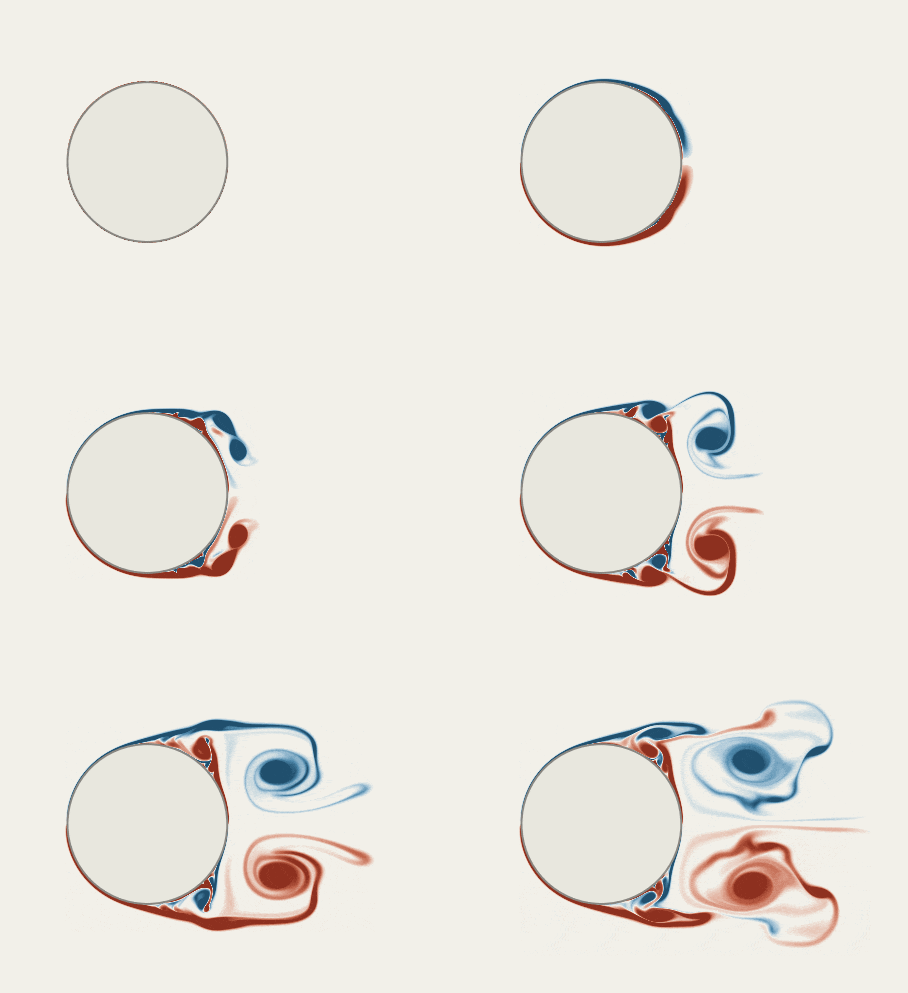
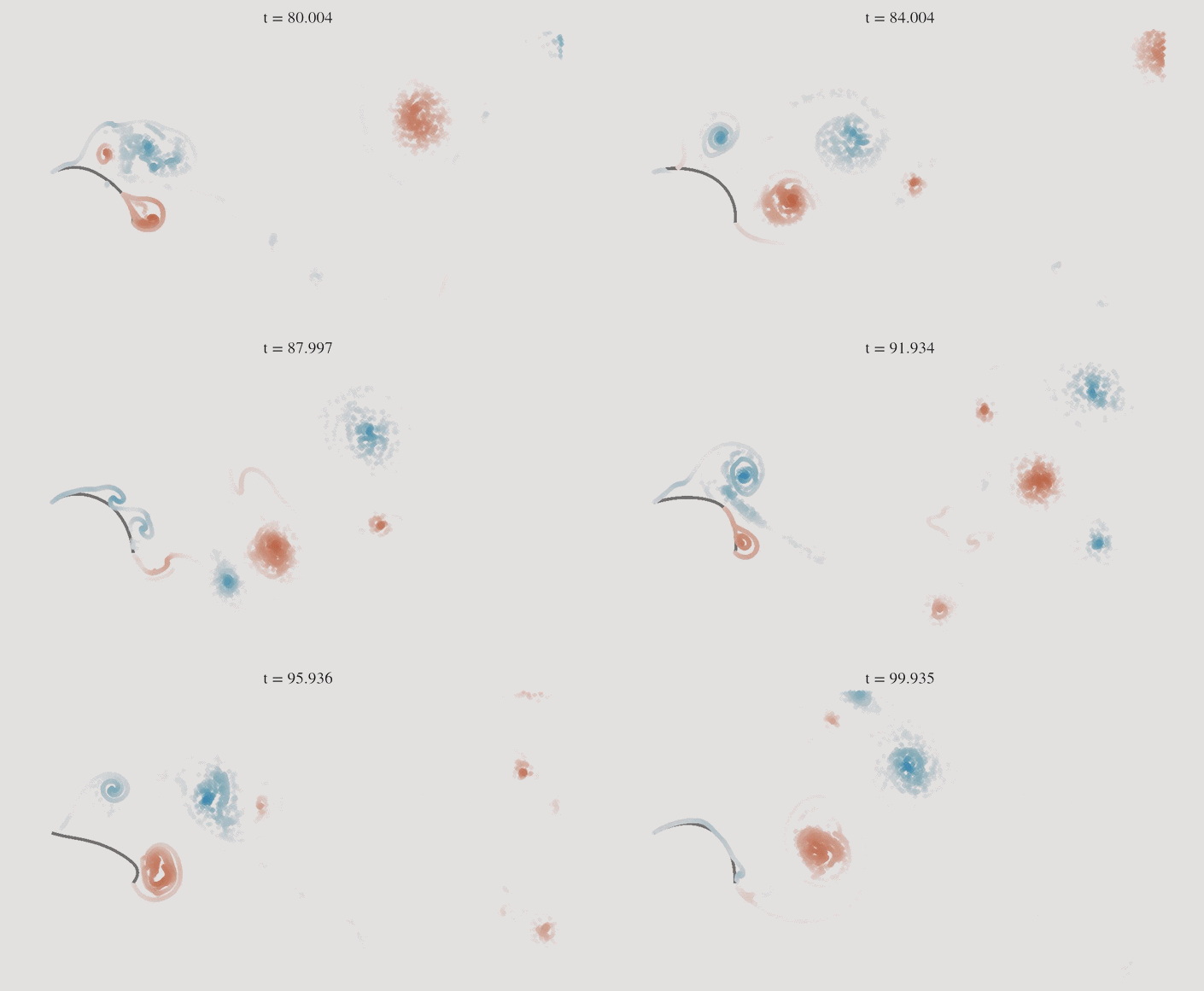
I develop fast, stable, and mathematically grounded physics-based simulation algorithms. I’m interested in flight, swimming, and the mechanics of thin elastic bodies in everyday settings: wrinkling sheets, snapping flags, flexible wings, and other familiar structures. You can see my research statement here. Recently I've also become interesed in quantum-inspired tensor networks as a means to accelerate simulation algorithms.
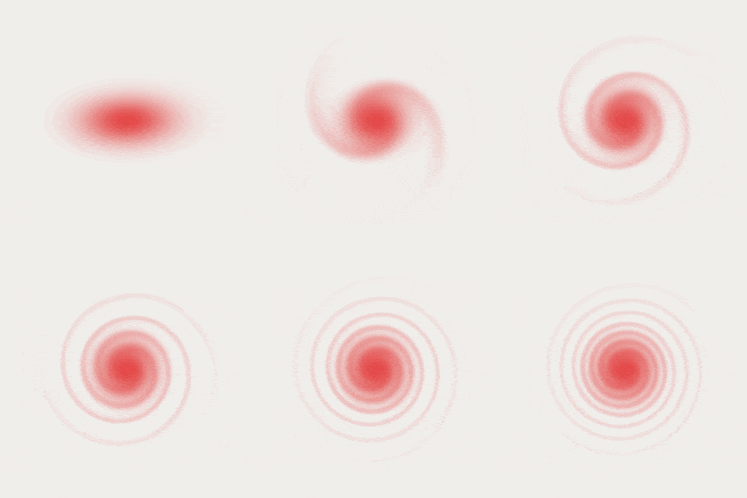
On a more fundamental level, I'm interested in numerical analysis, complex analysis, and partial differential equations; much of my work is secretly about the theory and computation of singular integral equations. Here's a little taste of what I've been thinking about!
Preprints
DiffVortex: A quantum-inspired fast solver for incompressible flows
By Yu Jun Loo, Silas Alben, and Shravan Veerapaneni
Submitted to Comm. Phys.
Abstract and Movies
Quantum inspired tensor representations such as Matrix Product Operators (MPO) and Matrix Product States (MPS) have recently emerged as a promising
framework for computational fluid dynamics, with logarithmic run time and memory scaling in mesh size when bond dimensions remain bounded.
Existing MPS-based solvers are grid based, and rely on compressing masks representing immersed bodies in the fluid.
Moving or flexible bodies complicate this approach: deformation requires updating MPS masks every time step, while filamentary vorticity in high-Reynolds-number flows may resist low-rank compression.
We propose a complementary approach: instead of compressing the fluid flow on the grid, we compress the evolution operator.
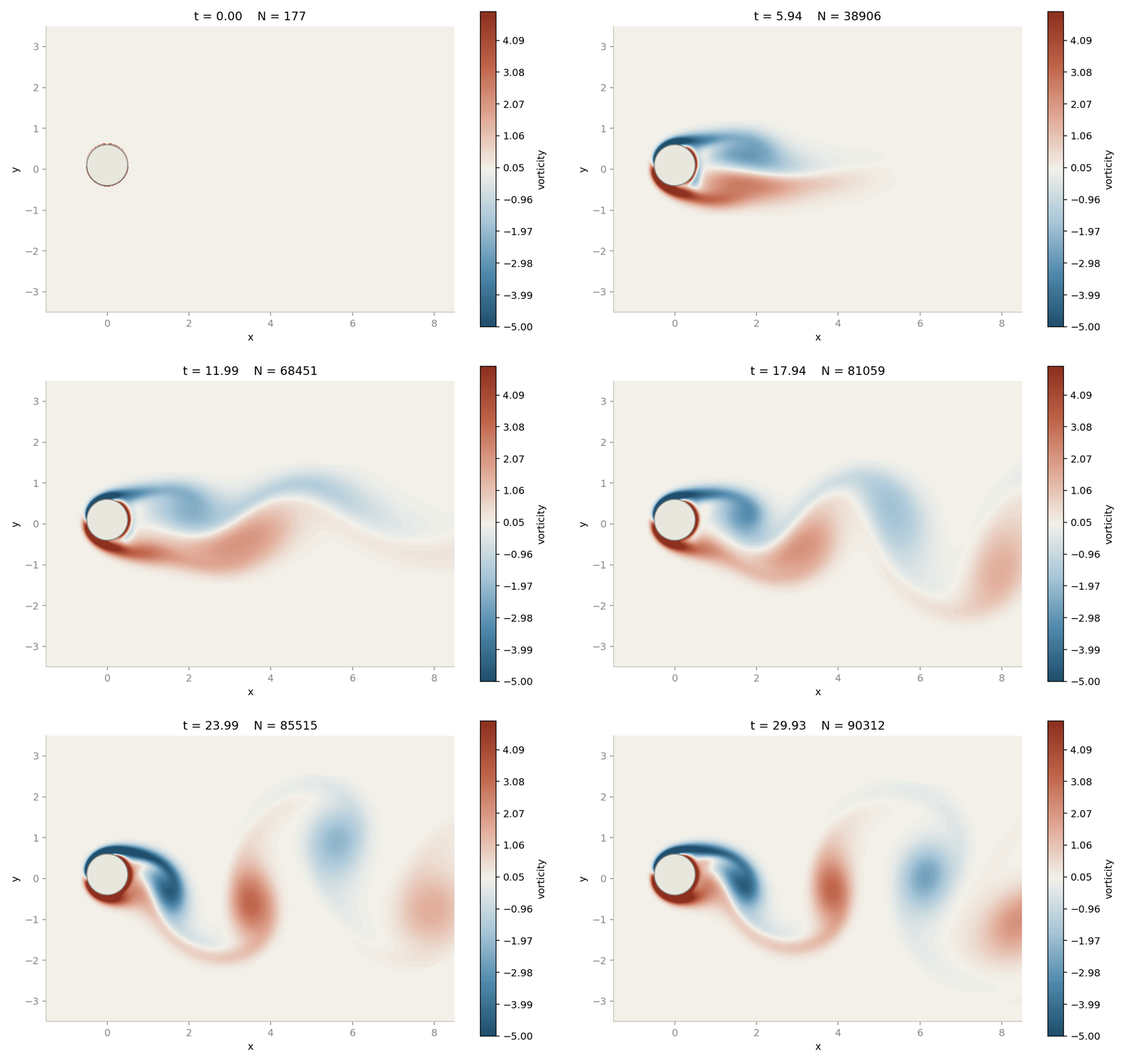
Instead, the fluid flow itself is compressed by a vortex-particle representation, and immersed bodies by bound vortex sheets on Lagrangian surface points.
Our main theoretical result is a lifting theorem: MPS rank \(r\) of the kernel implies MPO rank at most \(2^d r\) for the corresponding convolution operator in \(d\) dimensions, independent of grid resolution.
This bound is sharp for our interleaved ordering. With quantics tensor cross interpolation, the particle interaction operator becomes a tensor-network contraction with quasi-linear complexity.
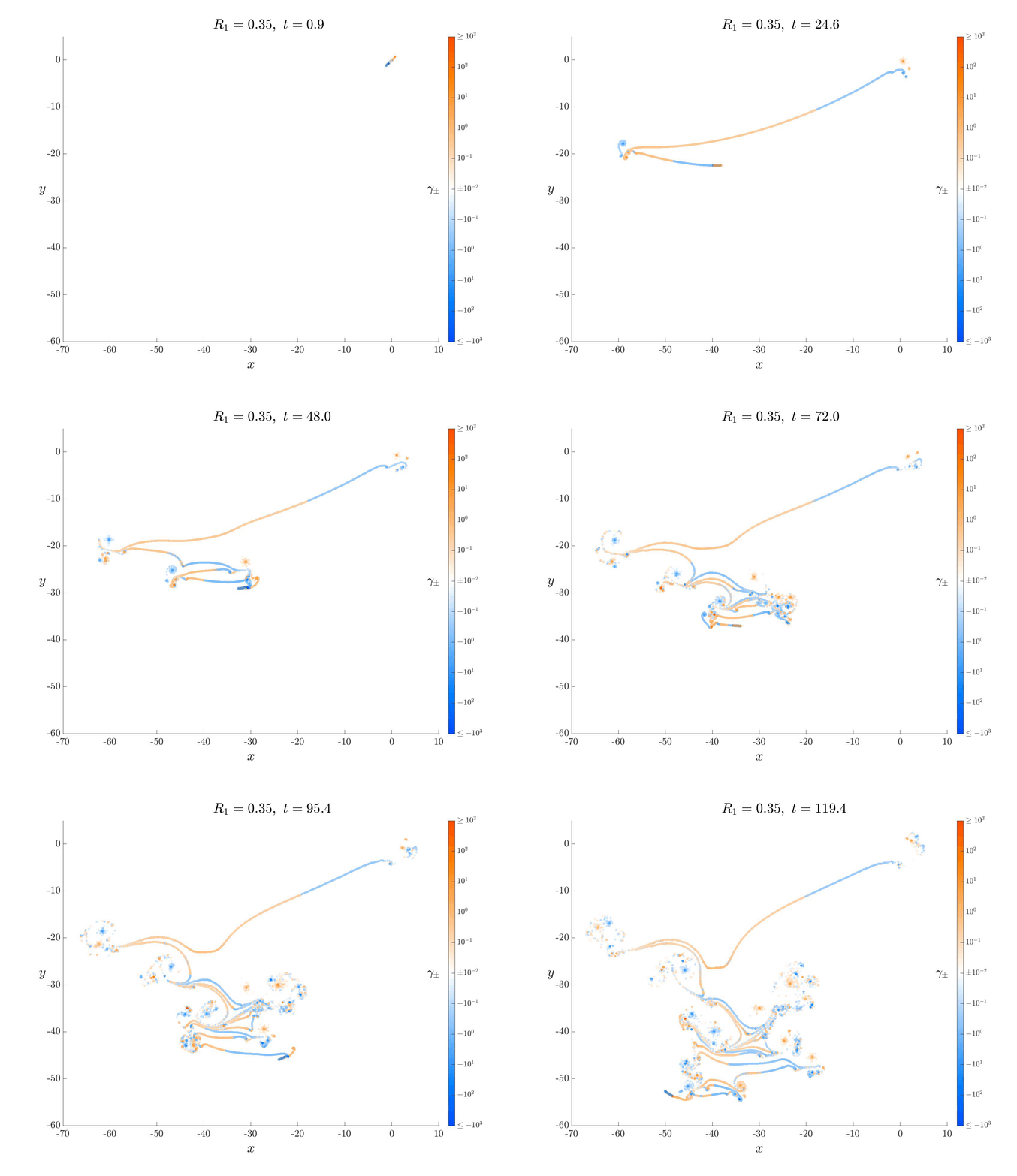
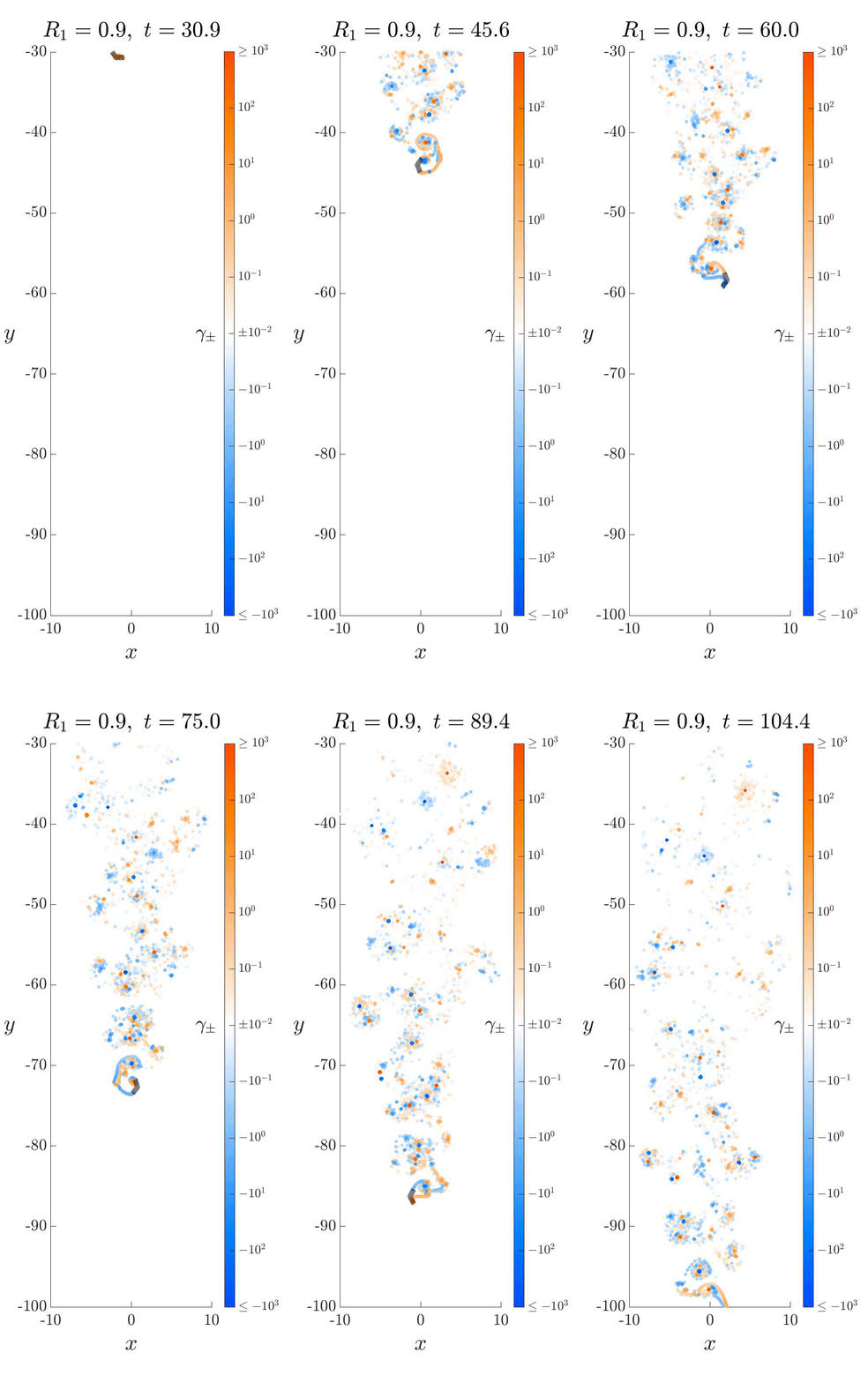
Our PyTorch implementation (DiffVortex) is end-to-end differentiable, runs on GPUs, and handles \(6.7\times10^{7}\) particles on a single device.
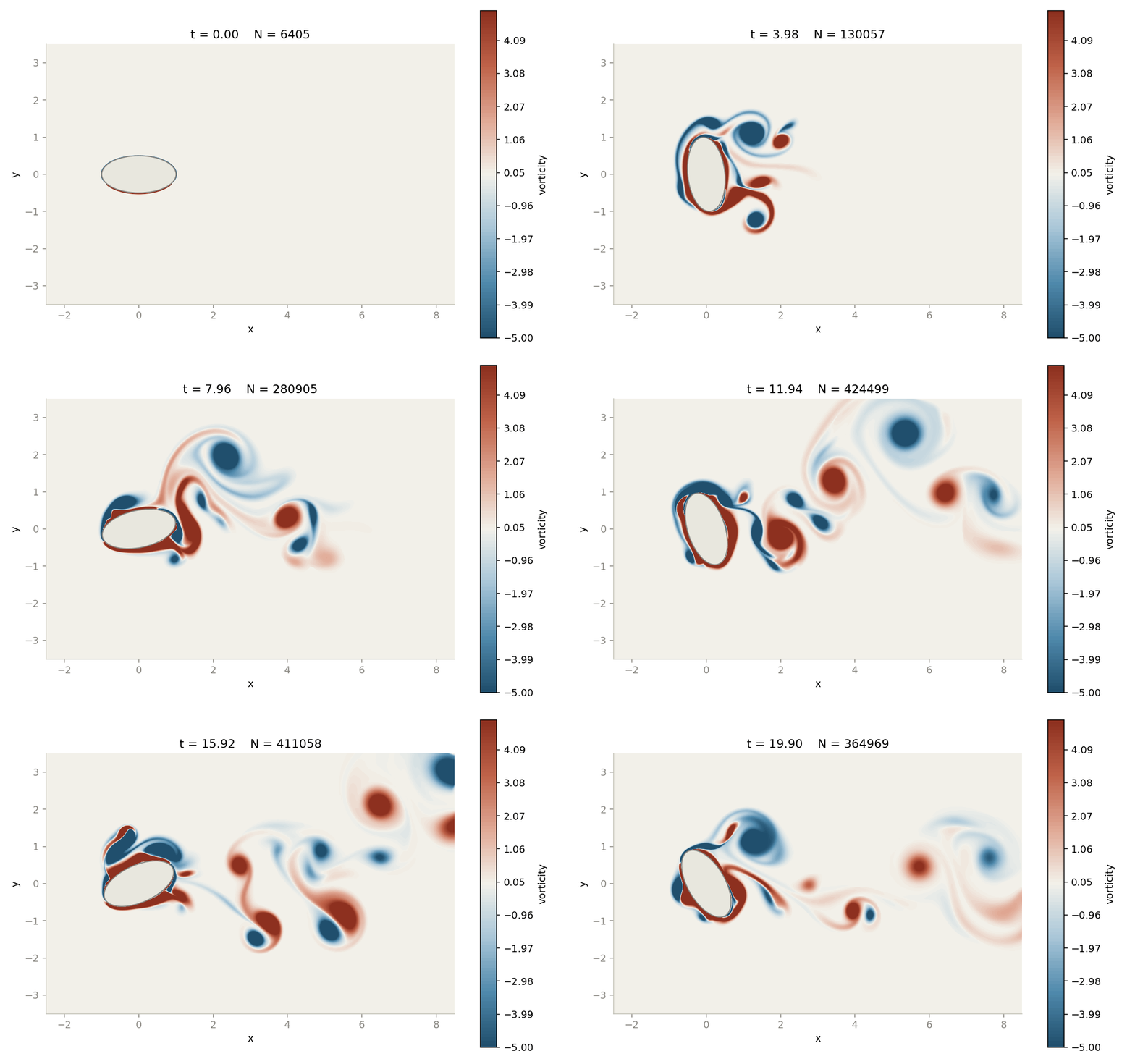
Extensible membranes in inviscid flow: aerodynamics and singular limits
By Yu Jun Loo and Silas Alben
Submitted to Phys. Rev. Fluids
Abstract and Movies
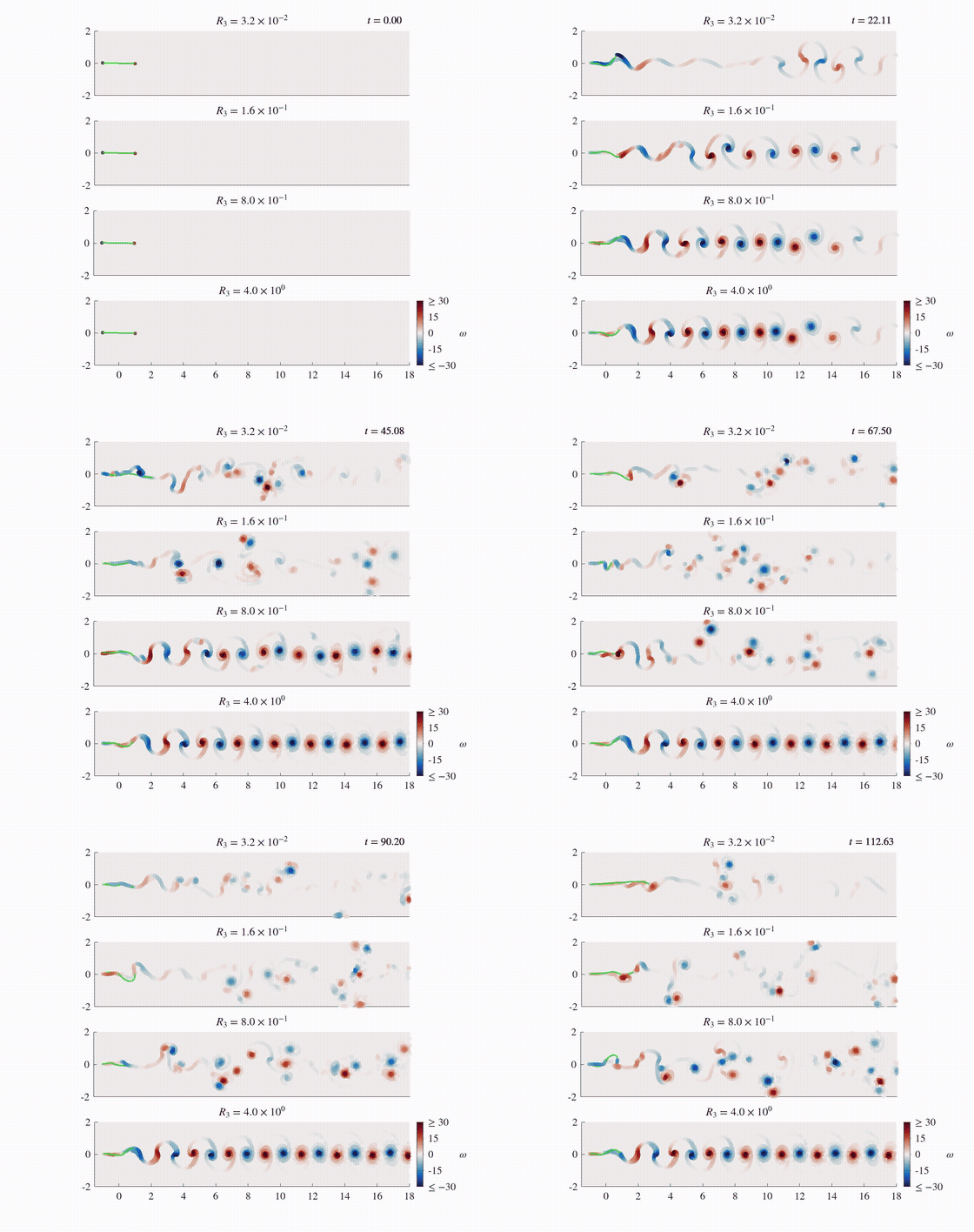
We develop a spectral galerkin solver for the membrane equation in 2D and couple it with our inviscid flow model from earlier work. This allows us to provide the first simulations of a membrane flag with exactly zero bending rigidity, whose trailing edge snaps at a high frequency (video). We show that the frequency of this snapping can be predicted with linear analysis, and that it obeys a rather surprising scaling law; decreasing bending rigidity increases the frequency inverse logarithmically. Similar techniques explain the wrinkling of heavy membrane sails when the attached vorticity stretches and "plucks" the membrane as it detaches.
Below we show the effect of increasing softness/extensibility (ie. decreasing \(R_3\)) on a membrane flag. When the flag is essentially inextensible, its undeflected state is unstable, and its dynamics are saturated by a stable periodic orbit. Decreasing \(R_3\) however, destabilizes the periodic orbit, and allows the membrane to return to the undeflected state by slowly retracting. The transition from periodic to chaotic fluttering can thus be explained by a homoclinic tangle, mixing the excursions towards and away from the once stable periodic orbit.
Publications
Comparing inviscid and viscous flows around moving plates
By Yu Jun Loo and Silas Alben
Journal of Fluid Mechanics
Abstract and Movies
Inviscid vortex sheet models provide fast, reduced-order descriptions of fluid–structure interaction by compressing the vorticity into a thin, lower-dimensional interface. For over a century, such models have been used to study unsteady aerodynamic phenomena. Yet their quantitative accuracy relative to the real viscous flows they seek to model has remained uncertain. Here we present a broad and uniform comparison between a single vortex sheet formulation and direct Navier–Stokes simulations across a large collection of plate maneuvers.
By enforcing consistent zero-thickness geometry and carefully resolving numerical singularities in both viscous and inviscid computations, we identify the regimes in which inviscid models accurately reproduce vortex dynamics and force histories, as well as those in which viscous effects are essential. Across most motions considered, the inviscid model achieves 10–20% average relative error. These results clarify the practical limits of inviscid modeling and support its use for the rapid exploration and control of complex unsteady flows.

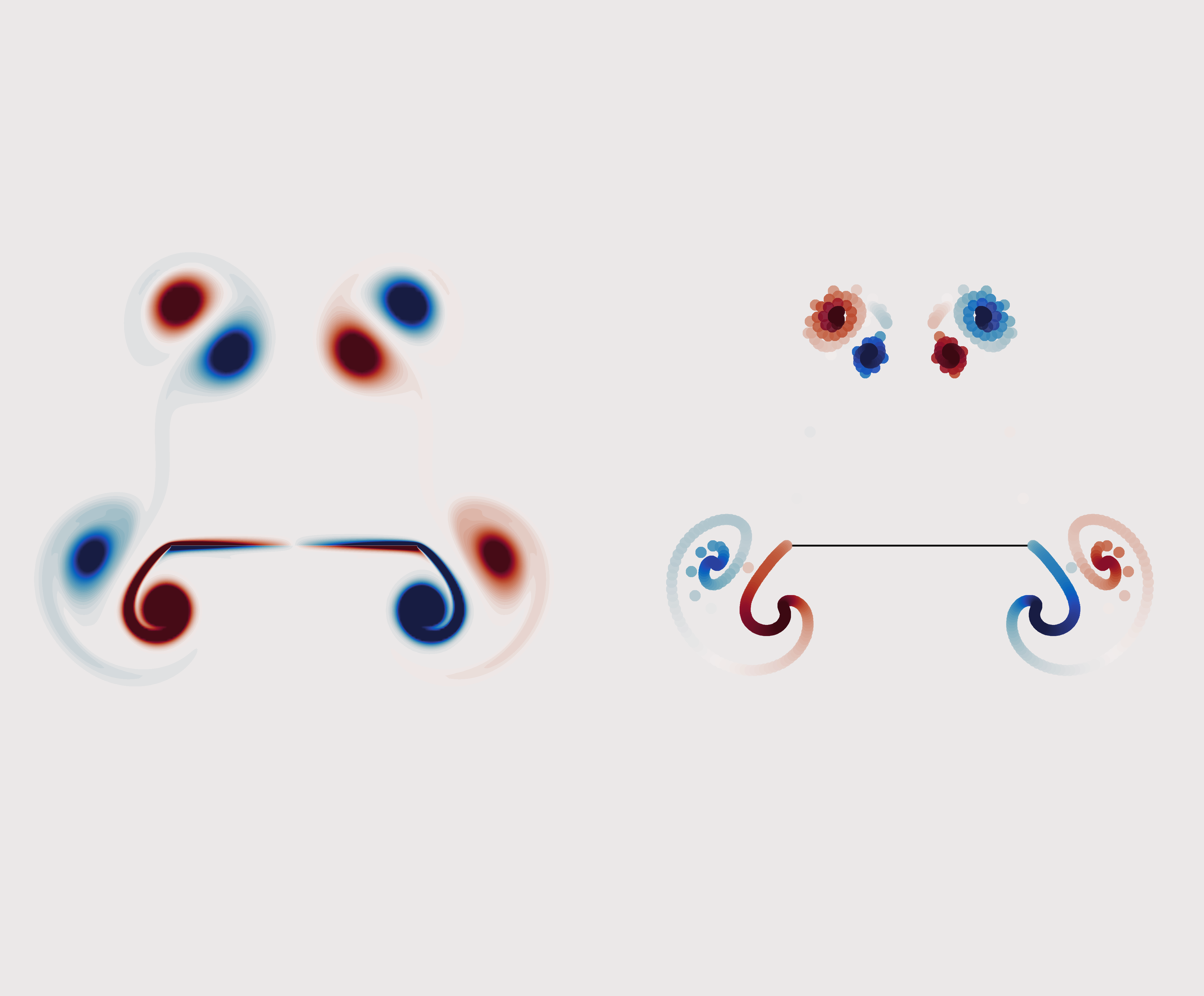
I gave a talk about this at the 20th U.S. National Congress of Theoretical and Applied Mechanics. Here are the slides !
Falling plates with leading-edge vortex shedding
By Yu Jun Loo and Silas Alben
Phys. Rev. Fluids , “Editors’ Suggestion”
Abstract and Movies
We developed a new vortex shedding model for falling thin objects (eg. leaves, wings) that captures the essential physics of these systems by incorporating leading edge shedding. Despite its simplicity, the model accurately predicts the transition point in density where fluttering transitions to tumbling. Here are some neat videos! The blue and orange are the vortex sheets, and capture the clockwise and anti-clockwise “spin” (called vorticity) at that spot. As the plate moves through the fluid, it injects angular momentum into it from its two edges, “dyeing” it blue and orange.
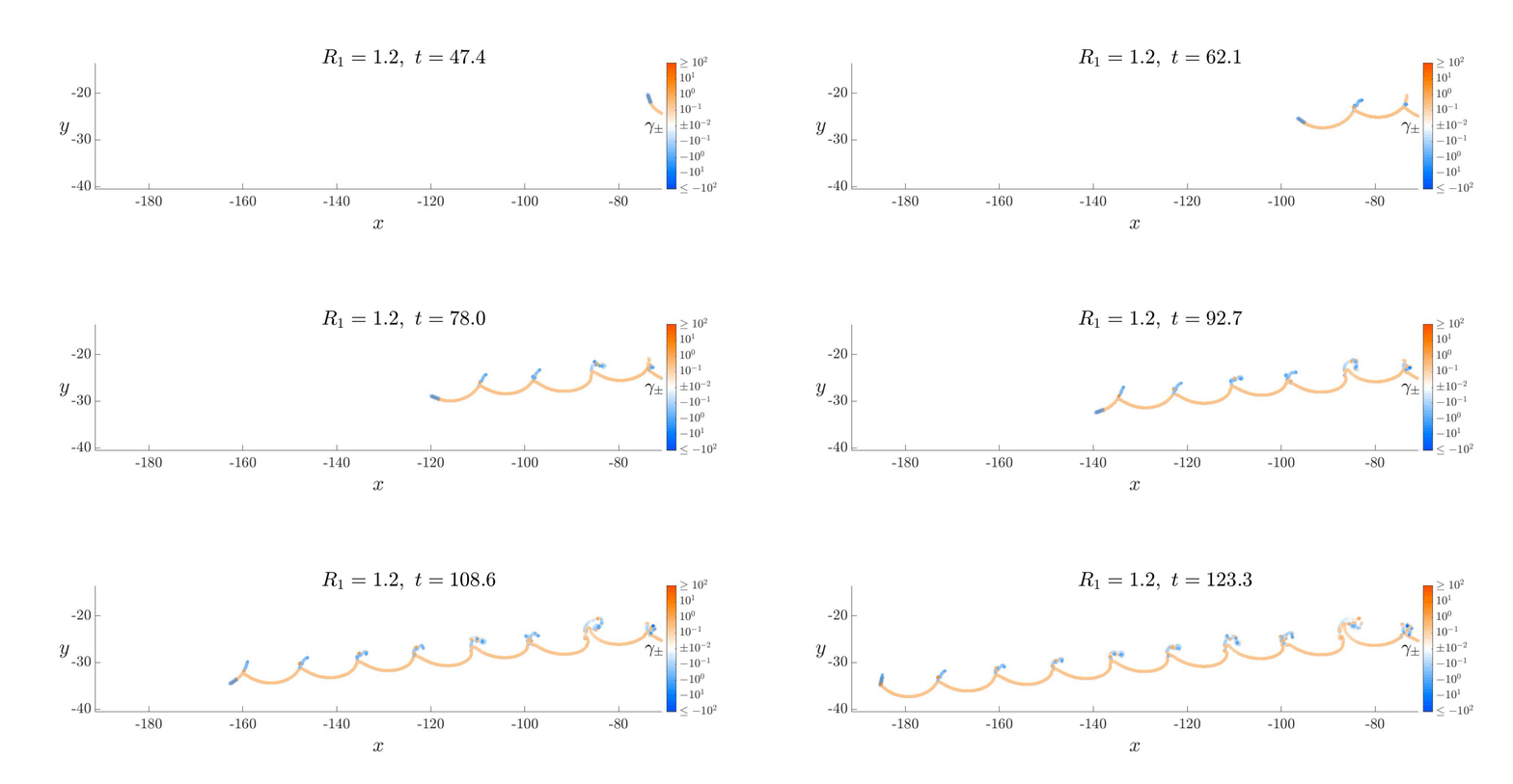
Each of these falling modes resemble different motions that can be observed in nature. For example, one can imagine birds exploiting the passive dynamics of the large amplitude fluttering motion above to efficiently glide from treetop to treetop with minimal effort.
I gave a talk about this at DisCoVor 2025. Here are the slides !
Hölder regularity of the \(\bar\partial\)-equation on the polydisc
By Yu Jun Loo and Alexander Tumanov
Complex Variables & Elliptic Equations
Abstract
We prove optimal Hölder regularity for a canonical solution operator to the \(\bar\partial\)-equation on the polydisc, using sharp estimates and techniques from harmonic analysis. This was a classical open problem in the field.
A key observation is that the unique solution operator whose Cauchy integral over the Shilov boundary of the polydisc (the torus) vanishes actually preserves Hölder regularity. As it turns out, this canonical operator appears in several classical guises in the literature, including the Henkin formula and the Nijenhuis–Woolf formula. By combining these seemingly different representations, we establish optimal Hölder regularity for the underlying canonical solution operator.
While our proof is carried out on the polydisc, the method extends to general product domains, though the required estimates become substantially more technical.